Showing posts with label easter. Show all posts

Friday, April 6, 2018

Photoessay: Vergers at the Vigil

If you visit Episcopal Cathedrals around the country, you will find that although we are a relatively small Cathedral, we have a mighty Verger Corps (see here for more about the vergers' roles).  Your vergers are responsible for the smooth running of the service, spending lots of time before, during and after the service, to ensure that what we may call the "choreography" of liturgy occurs seamlessly, with everyone knowing where to go, so that congregants and clergy can be fully immersed in the moment of worship.  Altar Guild is a key part of the "before" and "after", and Acolytes and Thurifer(s) a key part of "during" along with the Ushers.  Easter Vigil is probably our biggest service of the year, so what were your vergers doing? 


Verger meeting at 5pm with the Rev Brooks and Dean Penny, with Canon Verger Lisa
going over the detailed plan (called a "customary")

In the church working with Bishop Katharine and those to be baptised/ confirmed/ recieved
so they know the order of events.  The acolytes are here now.

Reviewing the Customary as the details are worked out (this is what theatre
folk call "blocking")

Verger Don and the Rev Brooks review the customary with Bishop Katharine

The Acolytes have a review with Canon Verger Lisa and the other Vergers

At the Back of the Church reviewing the order for Baptisms

Canon Lisa makes a point

Almost ready for the New Fire!  Verger Stephanie helps Verger Jeff with his celebratory white tie

As the Vigil begins, Canon Lisa monitors the customary

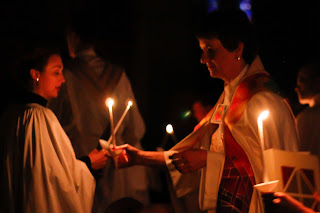
Vergers Stephanie, Jeff, and Cherie share the light, lighting candles along the main aisle


Sub-Verger Daniel holds the aspersorium for Bishop Katharine as she sprinkles Holy Water

There's always something!  Everyone is looking forward but Canon Verger Lisa and
Head Usher Lucinda confer in the back

Vergers read, chalice and do other roles as needed.  Here, Sub-Verger Daniel shares the Cup

And, Verger Stephanie leads the recessional.  Note her virge is upright.

Verger Cherie 

Verger Jeff

Verger Don, who was Bishop Katharine's Chaplain


Thursday, April 5, 2018

The Vigil Sermon: Risen to New Life

Alleluia, Christ is risen. The Lord is risen indeed, Alleluia!

Tonight you may have heard more Scripture read than you have ever heard before in a single worship service. Not only the stories, but the Psalms and canticles, and the prayers drawn from Scripture, all together giving us a rich and full sense of the God who created us, who redeemed us, and who loves us beyond measure.

The Creation, the Red Sea, the Dry Bones are ancient stories but they are still true today. We need to hear them over and over, because they repeat a rhythm, like the heartbeat our faith. All of human history bears the same rhythm of moving from chaos to creation, from death to new life, from sin to redemption. This rhythm, like our heartbeat, tells us that we are alive and that God is alive in us. And this life, this redeemed, renewed, resurrected life is only possible because our God is a God of life, a God of new possibilities, a God of unceasing and unconditional loving-kindness.

The one required Vigil reading from the Hebrew Scriptures is the story of the Exodus. God delivers God´s people from slavery in Egypt to freedom, and demonstrates divine power in simultaneously life-saving and deadly ways. Death and life are held in close tension; both are ever-present in our journey, both corporate and personal. This dramatic story prefigures the resurrection: the situation is dire; there seems to be no way out of certain oblivion. But then God acts in a totally unexpected way and life is restored for those who stay the course.

Tonight the risen Christ lives in us, and he has commissioned us to bring about the kingdom of God on earth. It is up to us to speak out with his voice, to insist on justice, to bridle greed and cleanse corruption, to look beyond our own interests to those of the people who have less than we do. There is no need to fear death, because death has already been transcended and defeated. Easter, as the final chapter in this millennia-long story of salvation, is all we need.

The message of this night is that God is the God of life, not of death. Death is present in our world, but God triumphs and transcends death. The doomed people are saved. The heart of stone is replaced with a heart of flesh. The dry bones are enfleshed and revived. God provides for all in a hostile environment, water in the desert, food for the famished. The God we serve is a God of surprises, of generative power, and of liberating love. God will not allow us to remain in slavery to Pharaoh, whether in the guise of abusive relationships, or complacent churches, or political structures that have become disfunctional, chronic conditions that are broken but not yet painful enough to prompt us to change.

God calls us into the light, to live fully, to risk failure, to discover just how much we can do, with God´s help. To seek and serve Christ in all, to uphold dignity, to strive for justice and peace: these are hard challenges and we are likely to fail. But we can do all things WITH GOD´S HELP, and only with God´s help.

This is the night. This is the night when all these stories, lessons, and promises come together. We hear once more the stories of God´s saving power, We tiptoe once more into the garden at the break of day. We strain our eyes to peer into the darkness of the tomb. We allow ourselves against all odds to feel an overwhelming joy, and to believe that love triumphs over death. We hear the command ¨Do not be afraid¨ and we pledge to live into that admonition. We strive for hope over fear, for love over indifference, for life over death.

Tonight we proclaim a hope of breath-taking audacity: that God is with us, that this world is worth saving, that love is stronger than death. We proclaim a hope for the world, that we also need to hear for ourselves, because in this hope lies a deeply personal yearning: that each one of us is also worth saving, that as broken and smeared with sin as we might be, God has the power to restore us to wholeness.

Our Eucharistic liturgy is the daily bread that nourishes this hope. We re-enact the sacrifice of Jesus each time we gather, in order to remember that we are saved, in order to once again lay down our lives and take up new life in Christ.

The toxic culture, the world of empire and of Pharaoh, will continue to tell us that our options are limited, that we are inadequate to the task of transforming the world. The resurrection of Jesus tells us that God defies all limitations, that life is enriched by endless diversity, that all things are possible with faith. We have only to put away our fear and dare to step out of the grave with Jesus, and, with God´s help, we are reborn into a new way, the way of life, and love, and peace.

Alleluia, Christ is risen. The Lord is risen indeed, Alleluia!

Easter Vigil 2018
The Very Rev Penelope Bridges

Tuesday, March 29, 2016

The Easter Sermon

Come Holy Spirit: Touch our minds and think with them, touch our lips and speak with them and touch our hearts and set them on fire with love for you. AMEN.

I.
In college, I was trained as a mathematician. I was particularly drawn to the mysteries of the unknown and unseen. My last year was spent delving into the mysteries of Number Theory. Indeed, my senior honors thesis was a proof of the existence of a number field. Thirty-five years later, and an almost equal time away from a discipline that requires all but full intellectual immersion, that paper holds seemingly ancient mysteries even to me, its author.

And yet, my intellect and my world view continues to be one in which I seek clear solutions. Things are to be proved or dismissed. I suspect each of us carries that post-enlightenment propensity and drive toward certitude, at least to some extent. Indeed, in this twenty-first century so much that surrounds us gives us precision and definitive knowledge. Want to know about your ancestry? You can send your DNA away for analysis. It can be proved. Want to see how long it will take you in traffic to get to Los Angeles? Enter the address in Google maps, which takes us to the most universal proving tool: your iPhone. If there is any dispute about the exact time, the immortal Steve Jobs will end the debate.

II.
And yet, the really big questions remain a mystery that cannot be answered. Our best guesses elude a proof. Why am I here? Am I really loved? Do I matter? When will I die? And what will that mean? Mystery and unknowing are always with us. We really want to get certainty around these things…including this business of Easter.

Yet, the best we can do is to go to the story told, that once upon a time: “Early on the first day of the week, while it was still dark, Mary Magdalene came to the tomb and saw that the stone had been removed from the tomb.” Within moments, this woman who had followed Jesus sets in motion a chaotic seen. She rushes back to the others and along the way she concludes that what she has seen is explained by grave robbers: “They have taken the Lord out of the tomb, and we do not know where they have laid him.” In an instant, an apostolic foot race is on between Peter and John. For days Peter has been running away from Jesus, but he turns and runs to find him. The beloved John wins the foot race but Peter enters the tomb first. What they see is linen wrappings and no corpse. Apparently Mary’s return to the tomb was less dramatic. But clearly the three are there. They are up to their eyeballs in mystery. Where is he? What does this all mean? We are told that John believed but did not understand. Whatever his nascent believing may have been, he and Peter returned home leaving Mary, thus setting the scene for an epoch encounter.

So far, all that has been reported can be explained. It is possibly just another ugly event in a horrible week—grave robbers, the Romans again, who knows? Mary’s weeping is understandable. But through her tears she is drawn to seek to know, and so she too looks into the tomb. This is something the impetuous Peter has already done. John had looked in, but not Mary. Now, in this moment of solitary grief, Mary looks in. And she sees that she is not alone. We are told that there are two angels, who ask her “Woman, why are you weeping?” Without any note of consternation or surprise by this heavenly appearance, roots her grief in the world, “They have taken away my Lord, and I do not know where they have laid him.” For Mary, Jesus is still dead. Angels do not take her to the resurrection. She just wants to know where the body is so she can grieve properly. She is trying to order her thoughts and feelings in this broken world where Romans crucify, terrorist blow up bombs, cancer wins, and the dead stay dead. In this story, you and I are Mary. We stand at an empty tomb and ask, “What does all of this mean?”

III.
It is at this point that Mary hears another voice. It comes from behind her. We know this because she turns around and sees a man she thought was the gardener. And it is when this man speakers her name, that she recognizes him to be Jesus. It is that intimate and loving knowing that is conveyed by knowing and speaking the name of another that leads to recognition: “I am the good shepherd. I know my own and my own know me.” Mary… Rabbouni!

And yet, what makes this recognition happen, what takes Mary from the emptiness of the tomb, looking for the dead body of Jesus, to facing the risen Christ, is the act of turning around. The Greek word used here is metanoia. It is this moment and movement of reorientation that allows her to encounter the holy. It is in turning that she finds a new direction and the opening of new life. All of this propels her to then be the apostle to the apostles: “I have seen the Lord.”

Dear ones: today, I offer you no proof of the resurrection of Jesus. I am a descendent of the apostles and pass on to you the experience of Mary, Peter, and John. They experienced not just an empty tomb, but the physical resurrection of Jesus. Mary told her experience and for 50 more days Jesus kept gracing them with opportunities to change directions and live resurrected lives.

I want to be absolutely clear in my proclamation this day. We proclaim that Jesus died on the cross and on the third day rose again. This is the proclamation. I cannot describe how. I cannot prove it. I believe it because of conversion that God gives to each of us. I believe. Help my unbelief.

IV.
What I also believe is that Jesus’ resurrection is a message to us to live lives that are changed and different. We are to be a community of Jesus that changes directions, like Mary, and turns around. What that ultimately looks like is a people of God that trusts in life with God beyond this world, and so can risk living today for the least in this world. Again, we cannot prove this like a mathematical question. We have to take it as a matter of believing that if we follow this Lord Jesus we will find life and have it abundantly in this age and in the age to come.

When I was a college senior defending my honors thesis, a curious thing happened. The presentation was in front of the department faculty. About halfway through the proof, Dr. Ebby found a mistake in my work. The wheels started to come off the bus. But then Dr. Alvarez found a second mistake. Those were corrected, a crash was averted, and I reached the blessed conclusion. I think this business of following Jesus in the way is a bit like that. We may think we are on a fact-finding journey, but really we are on a pilgrimage in which we gain insights from our fellow pilgrims. The final resolution or answer is ultimately not ours to claim or grasp but is given us in the fullness of time as a gift.

 Beloved: today we rejoice in that gift. Jesus is Christ is risen today. Alleluia. Let us turn with Mary and see him. And then, let us tell others the news by our words and as we live resurrected lives of giving, service and love. The Risen Christ is behind you. Turn around! Do you hear him calling your name?


John 20: 1-18
Easter Sunday, March 27, 2016
St. Paul’s Cathedral, San Diego
The Right Rev James Mathes

Easter Vigil Sermon: This is the night

Alleluia, Christ is risen! The Lord is risen indeed, Alleluia!

This is a night unlike any other night. The Exsultet, that Martin sang so beautifully, gives it poetic expression:
       This is the night when God brought our ancestors out of bondage.
       This is the night when all who believe in Christ are restored to grace.
       This is the night when Christ broke the bonds of death and rose victorious from the grave.

Funny thing about those three statements: two are about the past, one is about the present. Tonight we mix up the long ago and far away with the here and now. It's a potent mix.

When I was in grammar school I was taught that it was bad form to mix tenses in a story. Now that I am working on my Spanish, I'm struggling to distinguish correctly between present, praeterite, and imperfect tenses. It doesn't help that sometimes the same word is used for both present and past tense.

But on this night, present and past come together, and we can use the same words, for Christ is risen! On this night, the primordial creation and our rebirth in the Spirit meet in the empty tomb. On this night, we celebrate the awesome power of God's life-giving Spirit, no less active in us today than it was when it moved over the face of the uncreated waters. All of salvation history is collapsed into a single, transformative liturgy as we find our way from the darkness of the grave, even of humanity's very womb, to the light of resurrection and renewal.

In the beginning, God created the heavens and the earth ... The great stories of our faith have been told and shared over millennia, but they haven't lost their power. Each story we've heard tonight centers on the same unchanging truth: our God makes promises to us and then delivers on them.

In Genesis, God creates a home for us and promises to provide everything we need.

In the Exodus, God liberates the faithful from captivity and obliterates their enemies. (This story, by the way, contains one of the most sinister promises in all of Scripture. I wonder if you caught it: "The Egyptians whom you see today you will never see again.")

The prophets give us assurance that God's word does not return to God empty but bears fruit, that God will gather us and cleanse us and will be our God no matter what, that God will raise the dead to new life, and that we shall truly live and know that the Lord has spoken and will act.

Those are the ambitious promises that God offers to all of humanity, promises we can trust.

And we see the promises fulfilled tonight. This is the night. The Easter Gospel, as Luke tells it, has the mysterious beings at the tomb - let's just call them angels - ask the women a rhetorical question: "Why seek the living among the dead?" At that moment, those women knew only of death. They had come to perform the heartbreaking task of preparing a body for burial. They were deep in grief and shock. They weren't looking for life. So it took them a little while to grasp that something amazing had happened. It took the angels saying, remember what he told you. And as they remembered, they began to understand. They took the step from despair to hope. They stepped from the darkness into the light. And then they went to rejoin the living; and they shared what they were realizing with their friends. It was a process, not a moment.

And, just as it was for the women, so it was for the men. They too had to make the journey from disbelief to faith. First, they had to move beyond their own automatic dismissal of the women's story. It seemed to them an idle tale. Well, what do you expect from a bunch of silly women? After all, women didn't even count as valid witnesses in court. They were so insignificant that they could weep over the body of an executed criminal and then go out in public without fear of being recognized and arrested, because they were functionally invisible. The male disciples, represented by Peter, had to see the empty tomb for themselves before they would believe.

And what they came to believe, was that God's promises to humanity, made in creation, in liberation, in exile, in Word bearing fruit and in mighty act reviving a people, all those promises had been fulfilled, once for all, in the resurrection of Jesus of Nazareth from the dead.
This isn't just a story that happened long ago and far away. It's a story that continues to be told and to be true in the lives of faithful people today. Why seek the living among the dead? Too often we find ourselves living among the dead, clinging to dead ways of being, worn-out ways of relating to one another, lifeless idols of security and success, when we only have to look up from the grave to discover that God is offering us life, a life more abundant than any story can describe, a life that we can share with the world.

The promise of this night is that God's power knows no limits. Resurrection breaks all the rules, but it happened, and it continues to happen every time we encounter the risen Christ.

As we live into the reality of resurrection we are driven to bring life to the lifeless, to share the Gospel as those women once shared it, to make the story our own and to offer the world the one promise that will never be broken, the promise that God is with us always, that Christ is alive in us.

For this is the night when all promises are fulfilled, and all Creation shouts for joy.

Alleluia, Christ is risen. The Lord is risen indeed, Alleluia.

Easter Vigil
March 26, 2016 
The Very Rev Penelope Bridges  


Friday, April 2, 2010

Good Friday


So they took Jesus; and carrying the cross by himself, he went out to what is called The Place of the Skull, which in Hebrew is called Golgotha. There they crucified him, and with him two others, one on either side, with Jesus between them. Pilate also had an inscription written and put on the cross. It read, "Jesus of Nazareth, the King of the Jews." Many of the Jews read this inscription, because the place where Jesus was crucified was near the city; and it was written in Hebrew, in Latin, and in Greek. Then the chief priests of the Jews said to Pilate, "Do not write, 'The King of the Jews,' but, 'This man said, I am King of the Jews.'" Pilate answered, "What I have written I have written."
John 18.


Hieronymous Bosch, Christ Carrying the Cross, 1485-1490

Thursday, April 1, 2010

Maundy Thursday


And during supper Jesus, knowing that the Father had given all things into his hands, and that he had come from God and was going to God, got up from the table, took off his outer robe, and tied a towel around himself. Then he poured water into a basin and began to wash the disciples' feet and to wipe them with the towel that was tied around him. He came to Simon Peter, who said to him, "Lord, are you going to wash my feet?" Jesus answered, "You do not know now what I am doing, but later you will understand." Peter said to him, "You will never wash my feet." Jesus answered, "Unless I wash you, you have no share with me."

John 13

Giotto di Bondone, Washing of Feet, 1304-06. Cappella Scrovegni (Arena Chapel), Padua.